Visualizzazione post con etichetta PFDJ. Mostra tutti i post

mercoledì 4 novembre 2009

MILITARIZED DIPLOMACY: LA POLITICA ESTERA ERITREA TRA CONTINUITÀ E DISCONTINUITÀ (Parte II)

Asmara: identità, indipendenza e conflitti di uno stato “sviluppista”

L’identità eritrea emerse soprattutto in contrapposizione alla realtà imperiale etiopica subito prima dell’invasione fascista dell’Abissinia del 1935. Secondo gli storici, essa fu il prodotto di tre fattori principali. Primo, della crescita di un’ideologia discriminatoria indirizzata contro le popolazioni etiopiche assoggettate durante il colonialismo italiano, rispetto ad un popolo eritreo considerato sotto l’ombrello protettivo del “civilizzatore”. Secondo, del boom economico che si registrò in Eritrea subito prima dell’invasione italiana dell’Etiopia. E terzo, del ruolo delle truppe eritree nell’invasione fascista dell’Etiopia (si calcola che circa 50.000 unità dell’esercito italiano fossero allora costituite da ascari). Queste tre caratteristiche contribuirono alla nascita di un primo “confine” tra la colonia italiana e Addis Abeba, concorrendo non poco alla formazione dell’identità eritrea e al mito del paese come zona più sviluppata dell’impero, convinzione questa radicata in parte anche nella retorica della guerra di liberazione.

Dopo la sconfitta italiana nella seconda guerra mondiale, l’Eritrea fu temporaneamente posta sotto amministrazione fiduciaria britannica, prima che l’ONU decidesse di federarla all’Etiopia nel 1952. La sua completa annessione da parte di Haile Selassie come quattordicesima provincia dell’impero nel 1962 scatenò anche la prima resistenza armata sul territorio. L’Eritrean Liberation Front (ELF) cominciò delle azioni di guerriglia già nel 1961, ma nel 1970 una piccola fazione del gruppo si separava dalla formazione originaria, prendendo poi il nome – nel 1975 – di Eritrean People’s Liberation Front (EPLF). La tensione tra l’ELF e l’EPLF si concluse solo nel 1982, quando l’ELF fu sconfitto dall’EPLF, che rimase così l’unico movimento di contrapposizione al regime di Menghistu, che nel frattempo aveva destituito tramite un colpo di stato militare l’imperatore Haile Selassie. L’Eritrean People’s Liberation Front riuscì, infine – anche grazie all’aiuto indiretto di altri gruppi di opposizione alla giunta militare etiopica, come il Tigray People’s Liberation Front (TPLF) e l’Oromo Liberation Front (OLF) – a liberare la città di Asmara, e così l’Eritrea, il 24 maggio 1991. Dopo la caduta del Dergue nel giugno del 1991, la coalizione che aveva contribuito alla sua sconfitta, l’Ethiopian People’s Revolutionary Democratic Front (EPRDF), prese il potere in Etiopia, dichiarando un periodo di transizione di due anni prima di indire un referendum sull’indipendenza eritrea. Nell’aprile del 1993 gli eritrei si espressero in favore dell’indipendenza, e così nel maggio dello stesso anno l’EPLF dichiarò il paese come uno Stato indipendente, il quale nasceva dai medesimi confini ereditati dall’ex colonia italiana. La configurazione dell’Eritrea nello scacchiere internazionale e regionale ha evidenziato come i suoi confini siano stati discussi e modellati nel tempo da forze prettamente “esterne”. Il paese pertanto può essere descritto come una classica “terra di confine”, un’entità territoriale posta da sempre in aperto conflitto con i suoi importanti vicini, come lo stato etiopico, quello sudanese e quelli arabi che affacciano sul Mar Rosso.

Le basi ideologiche per lo sviluppo politico dell’Eritrea post-guerra di liberazione sono poi state trascritte nella National Charter for Eritrea, approvata dal terzo congresso dell’EPLF/PFDJ nel febbraio del 1994.
Proprio durante questo congresso il Fronte decise di cambiare il proprio nome in People Front for Democracy and Justice (PFDJ), con l’intento di sottolineare la conclusione della guerra di liberazione e il passaggio dell’amministrazione da un’ala militare ad una civile.
Una delle prime misure prese dal PFDJ per rafforzare il senso di appartenenza nazionale fu proprio quella di imbastire una leva militare obbligatoria per tutti gli uomini e donne che avessero raggiunto almeno un’età di diciotto anni. Unendo così in un unico esercito giovani Kunama, Afar, Beni Amer e Tigrini, il nuovo governo cercava di accrescere e cementificare lo stesso spirito nazionalista sperimentato durante gli anni di lotta di liberazione.

Quando l’Eritrea raggiunse l’indipendenza formale nel 1993, il proprio confine con l’Etiopia era ancora fissato da una serie di trattati coloniali italo-etiopici (segnati nel 1900, 1902 e 1908). Nonostante questo, la frontiera non venne mai totalmente demarcata, causando non pochi problemi di usufrutto delle terre e dispute amministrative in diversi villaggi. Il 6 maggio 1998, un piccolo gruppo di soldati eritrei entrava in un’area contesa nei pressi del villaggio di Badme, che comunque si trovava sotto amministrazione etiopica fin dal 1962. Il piccolo e circoscritto confronto a fuoco che ne seguì causò l’acuirsi di una tensione ben più estesa, che portò allo scoppio di una vera e propria guerra transfrontaliera. A seguito dei bombardamenti etiopici sulle città di Massaua, Asmara e Assab, il paese accettò un documento di pace stilato dall’allora Organizzazione dell’Unità Africana (OUA). Così, nell’agosto del 1999 entrambe le parti in conflitto accettarono in principio la mediazione dell’OUA, che portò – dopo un massiccia offensiva etiopica nel maggio del 2000 – all’accordo di Algeri, siglato il 18 giugno del 2000. L’accordo prevedeva la creazione di una zona cuscinetto lungo tutto il confine eritreo-etiopico larga circa 25 Km e denominata Temporary Security Zone (TSZ). L’intera striscia di sicurezza venne situata interamente in territorio eritreo e presieduta all’origine da circa 4.000 caschi blu dell’ONU, appartenenti alla missione UNMEE (United Nations Mission for Eritrea and Ethiopia).

Il trattato di Algeri venne definitivamente ratificato dal primo ministro etiopico Meles Zenawi e dal presidente eritreo Isaias Afwerki nel dicembre del 2000. Inoltre, l’approvazione del disegno di pace inaugurava due commissioni, le quali avrebbero dovuto da un lato registrare e regolare le rivendicazioni dei due contendenti (EECM – Eritrea and Ethiopia Claim Commission) e dall’altro provvedere all’implementazione della demarcazione del confine (EEBC - Eritrea and Ethiopia Boundary Commission). La Commissione per i confini, in accordo con il proprio trattato istitutivo, aveva il compito di provvedere a una demarcazione sulla base di alcuni trattati coloniali ( trattati italo-etiopici del 1900, 1902 e 1908). L’organo, pertanto, non possedeva competenze tali da imporre decisioni sulla questione ex aequo et bono. In particolare, i suoi membri erano privi della facoltà di esprimere giudizi basati su principi di equità ma, al contrario, le proprie funzioni dovevano esclusivamente attenersi ai testi dei trattati istituiti in epoca coloniale. La decisione della commissione si concretizzò quindi nel marzo del 2003, sancendo – di fatto – il diritto di appartenenza eritrea sul villaggio di Badme. Il rifiuto etiopico della decisione dell’EEBC determinò, però, uno stallo nelle trattative sul confine, di cui ancora oggi non se ne riesce a vedere una soluzione.

La nuova escalation di tensione legata al contenzioso sul confine è stata inoltre accompagnata – tra il maggio 2005 ed il luglio del 2006 – dall’espulsione dei caschi blu europei, statunitensi e russi dall’Eritrea e da una riduzione consistente del contingente UNMEE, che oggi conta circa 2500 uomini (di cui 230 osservatori), così come sancito dalla risoluzione 1681 del 31 maggio del 2006. Nonostante i numerosi richiami del Consiglio di Sicurezza dell’ONU allo spirito di Algeri – accompagnati inoltre da vere e proprie minacce di sanzioni – entrambe le parti si rifiutano ancora oggi di sedersi nuovamente al tavolo delle trattative, sacrificando l’azione diplomatica a vantaggio di una nuova – ma non inedita – “delocalizzazione” del conflitto. Questa tendenza è stata inoltre testimoniata dall’entrata dei due paesi nell’intricata crisi somala, la quale ha visto l’allineamento di almeno due fronti ben distinti, che oggi vedono contrapporsi da un lato le istituzioni federali di transizione con sede a Baidoa e a Mogadiscio – sostenute e protette politicamente e militarmente dal governo Zenawi – e dall’altro l’Alleanza per la Liberazione della Somalia (ALS), nata nel settembre del 2007 ad Asmara sotto l’ombrello protettivo del governo Afwerki.
L’Alleanza per la Liberazione della Somalia (ALS) è un movimento di opposizione al Governo Federale di Transizione nato nel settembre del 2007 ad Asmara. Esso comprende circa 400 delegati, inclusi l’ex presidente della Shura dell’Unione delle Corti Islamiche Hassan Dahir Aweys, l’ex presidente del comitato esecutivo delle Corti Sharif Sheikh Ahmad, l’ex presidente del parlamento di transizione Sharif Hassan Sheikh Aden e l’ex vice primo ministro del governo federale di transizione Hussein Mohamed Farah Aidid.

Attualmente l’Eritrea è governata da un sistema a partito unico (People Front for Democracy and Justice – PFDJ), dove non esiste alcuna opposizione politica e dove il settore dell’informazione è tenuto ben saldo nelle mani dell’esecutivo attraverso il ministero dell’informazione. L’economia e le sue forze produttive sono state interamente nazionalizzate. Il paese perciò – anche secondo la visione di numerosi analisti internazionali – corrisponde per molti aspetti ad un classico esempio di “stato sviluppista”. Infatti, il suo attuale sistema di governance si compone di due caratteristiche principali: una ideologica e un’altra più strutturale. La componente strutturale sta nel fatto che il potere politico basa la propria legittimità principalmente nella capacità di promuovere e sostenere lo sviluppo dall’interno, limitando al minimo i flussi di aiuto internazionale (ciò spiega anche la difficoltà di organizzazioni non governative a lavorare e promuovere progetti di sviluppo nel paese). A livello ideologico, invece, l’elite di governo deve essere capace in qualsiasi momento di imporre “un’egemonia ideologica” sulla società. In altre parole, gli anni che hanno contraddistinto l’operato del governo di Asmara sembrano essere sostanzialmente il frutto di un processo di state-building spiccatamente gestito “dall’alto” dall’elite politica al potere. Esso inoltre non fa che presentarsi significativamente in controtendenza rispetto allo spirito degli anni di lotta di liberazione e al tipo di accountability allora sperimentato, fatto di inclusività e partecipazione dal basso, soprattutto tra la popolazione rurale dell’altopiano.

domenica 18 ottobre 2009

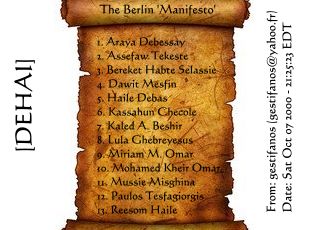
Il Manifesto di Berlino


Bookmark and Share


by http://asmarino.com/ 18 October 2009
Before the G15, there were the G13
“The Berlin Manifesto”
Letter to the President of Eritrea.


Berlin, October 3, 2000

H.E. Isaias Afwerki
President of the State of Eritrea
Asmara, ERITREA

Dear Mr. President:


We, the undersigned, Eritrean academics and professionals, concerned with the predicament facing our country, have agreed to meet in order to make a sober appraisal of our country’s current problems and to suggest appropriate solutions. Fully cognizant of your role in leading our nation to independence and mindful of your continued importance as a national leader, we decided to address this letter for your consideration and action.

Your comrades-in-arms trusted you as their leader during the liberation struggle. Your assumption of the office of President is a function of that trust. That trust and the responsibilities that it implies have never been more important than at this crucial moment of our history. We, as concerned Eritreans, also feel the weight of this responsibility. It is for this reason that we have come together to voice our concerns, and to exchange views and ideas which we submit as follows.

We would like to begin by expressing our unreserved support for our government in its defense of our country’s sovereignty and territorial integrity, and our admiration for the Eritrean defense forces and the entire Eritrean population for their role in foiling the Ethiopian aggression. But it is our firm belief that the military threat posed by Ethiopia cannot be dealt with separately from the political and economic challenges that confront us as a new nation. We are aware that the great promise of peaceful reconstruction and development has been shelved by considerations of national survival. However, we are also convinced that we can meet the present danger and future challenges if we unite our efforts and correct our past mistakes. The current crisis presents an opportunity to those ends.

I. A Hard-Won Independence Was Nearly Lost

Mr. President,

The experience of the last two years has been particularly painful but enlightening. As a nation we have been devastated by the Ethiopian invasion of our sovereign land. Indeed, the wound inflicted upon us by this war has been a chastening experience. Destroying towns and driving thousands of innocent citizens from their homes and even to foreign lands, the Ethiopian army’s deep penetration inside Eritrea and our sudden retreats shocked every Eritrean to the core and shook our nation to its very foundation. The very independence and sovereignty for which Eritreans paid with their lives and limbs was put at risk. We believe, had it not been for the resistance waged by our heroic defense forces and the unflinching support of our people, Eritrea would have almost been destroyed..

How did this come to pass? What are the causes of this tragic war? Why and how did the Ethiopians manage to penetrate deep into Eritrean territory with such speed and devastating effect? This war has not only cost us dear in life, property and in the suffering of our people. It has also raised grave questions about the conduct of Eritrean affairs both domestic and foreign, and about the nature and style of our leadership in the post-independence period.

Mr. President,

To ask why we have come to this impasse to inquire into what went wrong and to reflect upon the cause and conduct of the war, and whether it might have been avoided, is not only legitimate, but it is also the duty of every citizen. We hope that the Eritrean leadership, in its recent meetings, has done some soul searching and endeavored to provide satisfactory answers to these questions. We, on our part, took it upon ourselves, as concerned citizens who made modest contributions to our national struggle, to express our views on our nation’s current predicament and to offer some proposals as remedies. We hope and trust that you will consider these views in the spirit in which they are given, i.e., on the strength of our patriotic duties and our peoples proud tradition of love of truth and respect for the opinion of others.

The initial impulse that brought us together is manifold. First and foremost, it is the humanitarian crisis facing our people as a result of the war with Ethiopia. But we would be remiss, as concerned citizens, were we to ignore the other burning issues exposed by the current crisis facing our nation --political, social, and economic, as well as crisis in leadership.

II. Humanitarian Crisis and Eritreas Image

On the humanitarian question, we express deep concern for the tragic conditions of Eritrean victims of war. We are particularly concerned with the plight of the hundreds of thousands of Eritreans who have been affected by the war and the over 75,000 compatriots who were expelled from Ethiopia, and our citizens who are in refugee camps in the Sudan as well as those still languishing in Ethiopian jails and concentration camps. While we appreciate the Eritrean governments principled stand on the issue of deportation, we hope and trust that any deportation that may take place in Eritrea, if necessary and legitimate, would adhere to international law, and be in accordance with the previous practice of the Eritrean government.

We support the Eritrean National Assembly’s recent resolution condemning the criminal acts of the Ethiopian government, and we condemn the many egregious acts of violence, vandalism, rape and theft that have been perpetrated, and are being perpetrated, by agents of the said government against innocent Eritreans, In this respect, we pledge to commit our intellectual and financial resources in the ongoing effort to mobilize support. We trust the government to facilitate the timely delivery of humanitarian aid to our people in this time of need and we call upon every citizen to lend a helping hand in this effort.

Turning to another issue of concern, i.e., Eritrea’s image, we wish to assure you, on the basis of close observation, that Eritrea’s image has never been as bad as it is today. Indeed, it has hit rock bottom. There should be no illusions about this. Despite our belief in the rightness of our position, much of the world community, including our fellow Africans, perceive the Eritrean government and its leadership as aggressive and irresponsible. Eritrea’s leadership has been cast, particularly since the start of the war with Ethiopia, as contemptuous of international law and accepted norms of behavior.

Although Eritrea’s worsening image may have been affected by these charges, it is also true that we have alienated our friends and allies, including those who stood by us during the liberation struggle. Even the commendable policy of self-reliance, which many applauded, has now been portrayed as an aspect of arrogance. In our view, the problem is not the policy but its implementation. We know that there is a lot of room for improvement in the matter of implementing policies and in the manner of handling representatives of foreign bodies. Hence, there needs to be a critical reappraisal of policy and praxis.

III. The War and Critical Issues it Brought to Light.

We have followed with great interest and anxiety the unfolding of events since the outbreak of the war with Ethiopia. This tragic war has induced in us a need for critical review of the post-independence developments in Eritrea and particularly in our government’s performance. We recognize the fact that there are notable achievements in the fields of infrastructure, education, and social services. However, we have also noted developments that cause us considerable uneasiness and serious concerns about the future of our country.

Despite these disquieting developments, we remained remarkably silent. The reason for our silence was not due to apathy or lack of interest but rather due to the pervasive phenomenon of self-censorship. This self-censorship was particularly acute during the last two years because we all felt that criticism would give aid and comfort to the enemy who might distort it to suit its purposes. Now it is time to speak and speak plainly. Further silence can only endanger the interest of the country as well as compromise our historic responsibility. We must now say that, in our considered opinion, the government has lagged behind in the development of democratic institutions, including mechanisms for ensuring accountability and transparency. We respectfully submit that this is the most important matter for you to ponder and face squarely in whatever reappraisal of government policy and practice you may be undertaking, as we hope you are.

IV. Reconciliation and National Unity

We are convinced that we reflect a widely held view among Eritreans that there should be national reconciliation. Eritrean military victory and the assumption of sovereign nationhood should have been accompanied by a spirit of reconciliation fired by magnanimity the same magnanimity shown towards Ethiopians. Wisdom and statesmanship required a call for reconciliation extended to all Eritreans irrespective of belief or political affiliation to join hands in rebuilding a shattered society and economy. It is an opportunity that was lost but that can still he reclaimed. The EPLF (PFDJ) leadership should be willing now to provide political space for groups or individuals. The absence of such space has severely affected the development of civil society and has fostered a feeling of alienation among segments of our society. The constitution, about which we shall say more below, requires such space in no uncertain terms.

V. Collective Leadership and Popular Participation

Mr. President,

Considering the practice of the EPLF during the armed struggle, we believe that one of the grave mistakes that the government has made has been the abandonment of collective leadership. You do not need us to tell you that the practice had created trust and mutual confidence among the leadership and between the leadership and the rank and file. The heroic struggle of Eritrean fighters their tenacity and resilience in the face of overwhelming odds would not have been successful without such trust and confidence and the collective leadership based on it.

After independence this practice was abandoned and replaced by one-man leadership. It is also distressing to learn that individuals who were part of the leadership during the struggle have been inexplicably sidelined, in some cases with a loss of their use in this crucial time of crisis. This is inexcusable, and whatever the explanation for this negative development, we feel that it must be rectified. No individual leader, however gifted, can he a substitute for values that come with collective reflection and action in national affairs. The advent of one-man dominance has had the effect of suffocating a variety of ideas from blossoming and denied meaningful popular participation. It has inevitably prevented the growth of democratic institutions. A new nation with very limited and under-developed resources facing enormous challenges in all fields’ political, security, economic, social cannot afford to have a government that depends only on one person.

In fairness, the blame must also be shared by other members of the leadership to the extent that they did not object to the negative practices. They may have put up some feeble complaints, but we have heard of no such protests. So, they too have failed the nation along with you in allowing power to be concentrated in the hands of one man. The absence of any record of protest is also a function of the absence of freedom of expression which has prevented the citizens from exercising their rightful duty of restraining the undue accumulation of power in the presidency. Thus it is no exaggeration to say that, despite some notable progress to its name, the government has failed the nation in some important respect.

VI. Crisis within the Leadership

Mr. President,

It is not a secret that there is a serious contradiction and a major rift among the leadership. We cannot over-emphasize our apprehension of what may ensue. We deem it to be too serious and dangerous to he handled in a confrontational manner. Hence, we appeal to you and the rest of the leadership to handle it carefully, and to resolve all future conflicts within the framework envisaged by the constitution. Any further delay in resolving the crisis within the leadership will have grave consequences for our nation. We cannot minimize the potential weakness that this crisis may create if not handled properly, considering the opportunity that it can give the enemy to exploit our internal contradictions.

VII. The Role of PFDJ in Politics and the Economy

Mr. President,

We are particularly concerned about the parallel institutions of the PFDJ and the government. We see lack of clarity in functions. We see duplication and a bewildering variety of tasks and actors. We feel this involves confusion and waste of resources which a small nation with scarce resources can ill afford.

We would like to see a clear definition of what the PFDJ is. We would also like to see it confined to party activities and refrain from activities that are the proper province of government. The PFDJs economic activities are a cause for concern and an abuse of the goodwill and trust of the people. While it cannot be denied that PFDJ/government business activities have solved many problems by providing timely and affordable commodities to our people, this cannot he said anymore. In point of fact, PFDJ/government economic activities are contrary to the government’s policy of "a dynamic, private sector-led . . .market economy.. .and a commitment to private sector development... More to the point, PFDJ companies have no clear mechanism of accountability and transparency. At least, there is none that is known to the public. We believe that this is a recipe for disaster and for fostering corruption, cronyism, and favoritism. This climate discourages genuine and credible investors. We strongly believe that the current business practices of the PFDJ will act as corrosive agent of the political, social, and economic life of the nation, in any ease, and in view of the record of the PFDJ, it is important to seriously reassess the whole question of a party running business.

VIII. Implementation of the Constitution

Eritrea has a constitution the most sacred document of the nation. This constitution represents the consummation of the Eritrean struggle which was fought for self-determination, democracy, social justice and the rule of law. It was crafted with the participation of the people and was ratified by their representatives. It is the people’s document and no one has the right to suspend it or otherwise tamper with it. You were right when you said in your recent interview that the time for the implementation of the constitution was yesterday. [Iwanu ttnallyu neiru.] We agree, but we say: better late than never,

The constitution must be implemented immediately. A ratified constitution means that it is already in effect and that the Eritrean people should be enjoying their constitutional rights. We are dismayed to witness the operation of institutions that are clearly and flagrantly in violation of the spirit and letter of the constitution. We are astounded to hear of practices that are contrary to the provisions of the constitution continue today. We, therefore, solemnly request that you take the necessary steps to ensure the fill and immediate implementation of our constitution.

As a sign of goodwill and seriousness of intent, again, we would like you to abolish the special court which is undermining the rule of law and creating disaffection among a segment of our population. People have been languishing in jail for many years without being formally charged of any crime, let alone sentenced. They have been waiting to appear before the special court. This stands in stark opposition to the letter and spirit of the constitution and is an affront to elementary notions of justice. We urge you to set these people free immediately or have them brought before a court of law.

Another disturbing practice that is contrary to the spirit of the rule of law is the resort to arbitrary practices of freezing civil servants in what is popularly known as midiskal. This harsh and unfair practice, presumably intended to instill fear, seems to have been self-defeating. If the intent was to correct or rehabilitate the victim, or otherwise bring something good to government or the nation, it has not had that effect. The overall effect of the practice has been disillusionment, confusion and waste of valuable resources.

Conclusion

Mr. President,

Eritrea is at a crossroad. A portion of our land is under foreign occupation. A significant proportion of our population is displaced. It is time for a serious soul searching by all concerned, starting from the leadership. Let the leadership and the entire nation conduct an open debate. People should not be denied this right which they have paid for with their blood, sweat and tears. We urge you most sincerely to seize this moment of crisis and turn it into an opportunity to reclaim your hard-earned reputation as a leader. You owe it to yourself and to the nation and to wonderful people that has followed you through thick and thin.

On our side, we will spare no effort to help secure Eritrea’s territorial integrity and national sovereignty. At the same time, we will endeavor to promote a culture of openness, tolerance, accountability and rule of law. To these ends, we intend to broaden our base by convening a larger meeting which will consider your response to this letter. The idea is to begin and institutionalize a government/civil society dialogue on a continuing basis as a critical part of a healthy development of our future.

Respectfully Yours,
1. Araya Debessay
2. Assefaw Tekeste
3. Bereket Habte Selassie
4. Dawit Mesfin
5. Haile Debas
6. Kassahun Checole
7. Kaled A. Beshir
8. Lula Ghebreyesus
9. Miriam M. Omar
10. Mohamed Kheir Omar
11. Mussie Misghina
12. Paulos Tesfagiorgis
13. Reesom Haile

Contact person in Asmara Paulos Tesfagiorgis


And finally to President Issayas Afewerki,

“Is there no respect of place, persons, nor time in you? “

(William Shakespeare)

(1564-1616), British dramatist, poet. Malvolio, in Twelfth Night, act 2, sc. 3, l. 91-2. Reprimanding Sir Toby and his companions for their rowdiness at night.)


Bookmark and Share